8 weeks in class, then a 6-month paid internship for eligible students selected by a company
Hours
1,260 hours: 310 in class, 950 on the internship
Schedule
Monday to Friday, 7:15 AM to 4:05 PM, in person
Next starts
January 18, 2027 · March 22, 2027
You earn
Diploma
Cost
Your cost and funding plan, in one conversation
Where
1275 Rymal Road East, Unit 2, Hamilton, ON L8W 3N1
Approved as a vocational program under the Ontario Career Colleges Act, 2005.
What it is
Ready for any crew,from your first day.
Companies in every trade ask for the same things first: safety, tool skills, showing up, attitude and owning your work. The diploma teaches all of it, and students who pass and are selected by a company get a six-month paid internship.
01
Confidence on the tools
Measure, mark, cut and build to a standard with the tools every trade uses, alone and on a crew.
02
The habits companies trust
The eight competencies that make up work ethic, practised every day and scored every Friday.
03
How the business works
How a fully functioning trades company operates, from labour and logistics to pricing, winning work, and keeping customers.
04
A chance to prove it
After passing the classroom portion, students interview with companies. Students who are selected start a 950-hour paid internship.
Who it’s for
Built for peopleready to start.
Starting out
You have your high school diploma and want a career in the trades, not just a first job.
Not sure which trade yet
You want to start before you pick. The foundations are the same in every trade, so that’s where you begin.
Changing careers
You’ve worked in something else and want to move into the trades with the skills companies ask for first.
Who can apply? Anyone 18 or older with a high school diploma or equivalent can apply. The diploma is restricted to Canadian citizens and permanent residents.
What you get
Both halvesof the job.
Technical 07
01Measurement and trades math
02Hand tools and power tools
03A project you complete on your own
04A team build that puts several trades into one structure
05Site setup, tear-down and containment
06Your safety certifications
07A backpack full of tools you’ve mastered
Professional 06
08A resume built on what you can show
09Interview practice until it feels natural
10How to make the most of a first chance on a crew, and grow it into a career
11How a trades company runs, from building one as a team
12Estimating a real project
13Working with customers and presenting to them
A diploma, paid work experience while you’re in school, and you start ready for any trade.
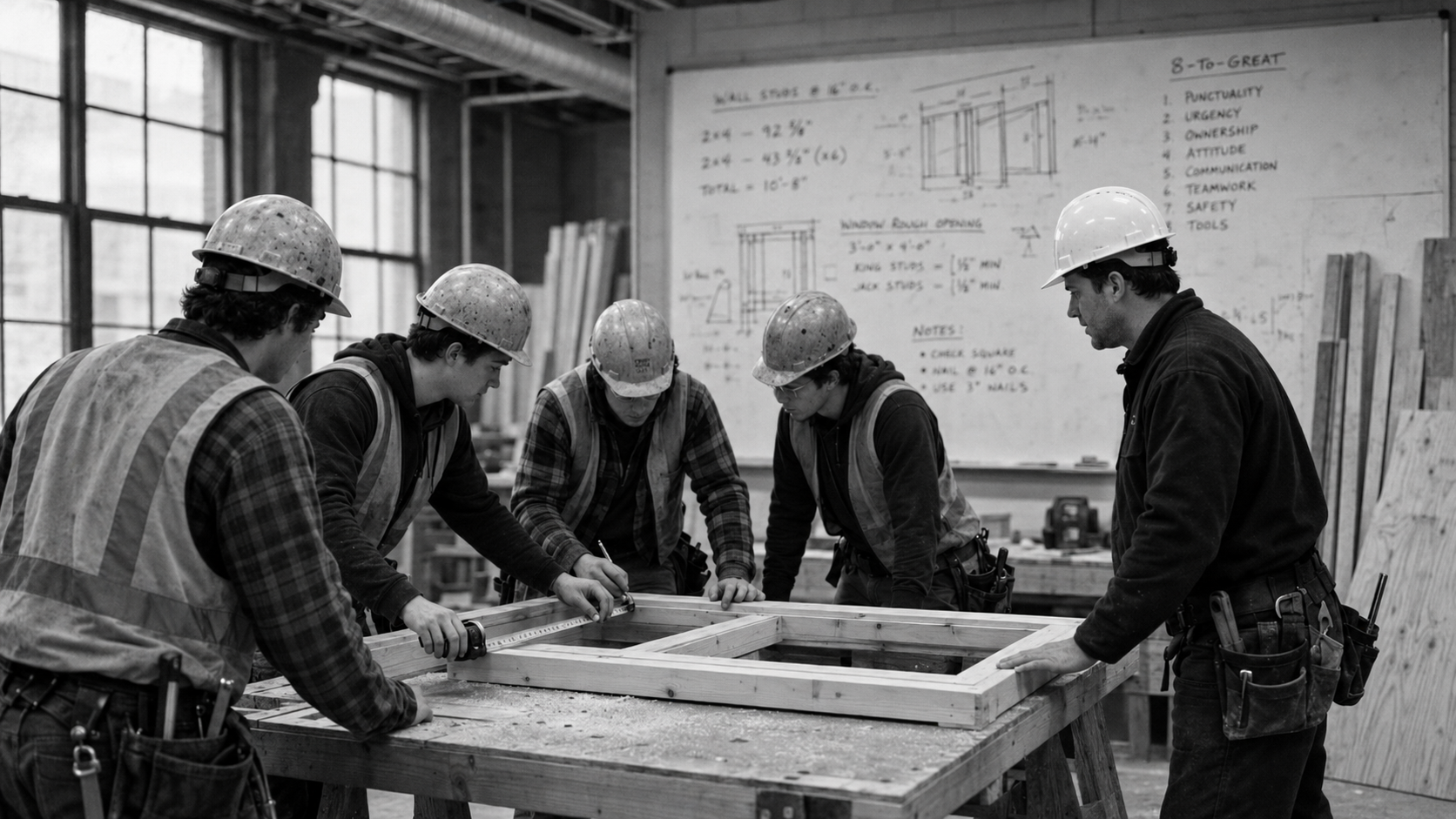
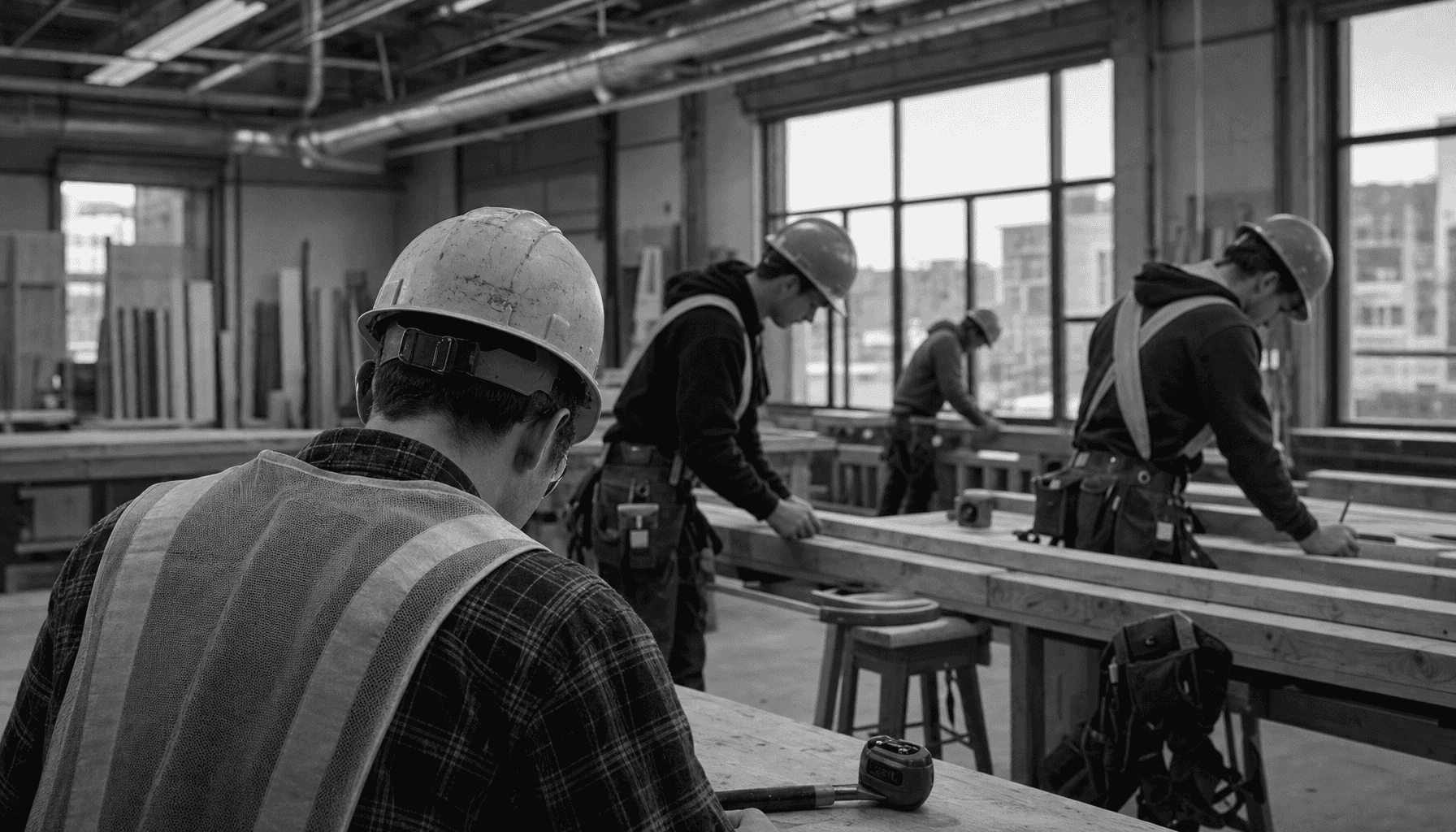
Class runs like a jobsite: 7:15 AM to 4:05 PM, Monday to Friday. Your technical and professional skills are built progressively from week to week and you get constant feedback on how to improve.
On the tools
Master Your Backpack
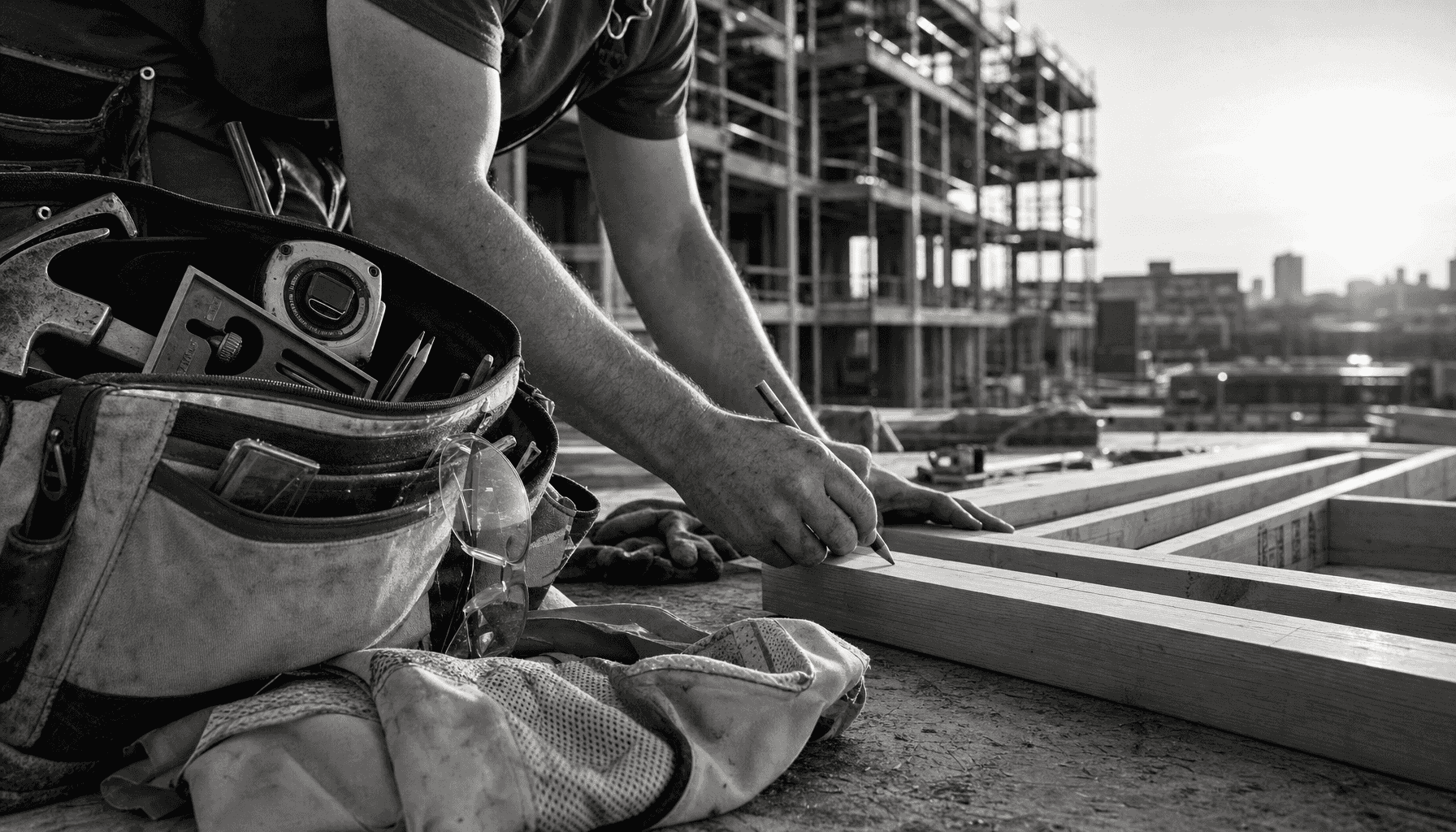
Master Your Backpack is the technical side, in stages. You get a backpack full of tools, and each stage builds on the last until you’ve mastered every one of them.
Stage 01
Measurement and trades math
Precision with a tape, squares and levels, and the trades math every job runs on. You must be fluent with basic trades calculations to be useful on a jobsite.
Stage 02
Hand tools
The hand tools every trade uses, on different materials, until they feel natural in your hands.
Stage 03
Power tools
Set-up, guards and safe use first, then repeat cuts and fastening until they’re clean and consistent.
Stage 04
An individual project
You work alone from a drawing and build to a standard, so you can show what you can do.
Stage 05
A team project
You build with a crew, in rotating roles, and learn how one trade hands the work to the next.
Stage 06
Site readiness
Setting up and closing down a site safely, inside and out, the way a real jobsite runs.
On the business
Three professional courses
Professional mistakes cost companies more than technical ones. So you practise every day on avoiding these errors, until we’re confident you can be an asset on a team.
Course 01
Self-leadership
Professionalism starts with personal responsibility. So you learn leadership skills, mindsets, habits and decision-making, so acting like a professional becomes automatic.
Course 02
Building Empathy
Understand all of the dimensions of a trades company, not just your job. Recognize how your work and attitude affect others.
Course 03
Customers and Sales
No company exists without customers. Learn how this basic insight affects everything within a trades organization.
Every Friday
The 8-to-Great
You’re scored every week against eight competencies, to show you can be trusted to go on an internship. Two are technical and six are professional. A failing score on any one triggers corrective action right away, just like on a jobsite. Pass all eight and you’re eligible for an internship.
Safety and Hazard Awareness
Tool and Measurement Competence
Punctuality, Attendance, Organization
Sense of Urgency
Sense of Ownership
Exemplary Attitude
Professional Communication
Teamwork
In week one, everyone scores a 1 or 2 in every category. You earn every increase, just like on a jobsite, and a score can go down if you make mistakes or don’t keep up the standard.
The internship
Get actual work experiencebefore you graduate.
01
Students who pass the eight weeks interview with companies in construction, industrial and motive power trades.
02
We have a network of companies and unions, and we put you forward for an internship.
03
Students who are selected start a six-month, 950-hour paid internship.
Is the internship an apprenticeship?
No. It’s paid work experience that is part of a diploma program. Hours earned during the internship may be counted toward an apprenticeship.
Where it fits
Different starts.One path.
Everyone we talk to starts from a different place, and wants the same thing: a career in the trades. Each program is a start on the same path, so wherever you begin, what you learn lines up with where you want to work.
Classes run from $899 to $1,995. For the diploma and certificate, you get the full cost in writing, with your funding plan, in one 30-minute conversation. Scholarships are available for both.
02
Is the classroom worth it if I’m not selected for an internship?
Yes. The classroom is the most valuable part of the program. It gives you all of the foundational skills and knowledge to get into the trades, advance toward an apprenticeship or Red Seal, or move off the tools into management, sales, entrepreneurship, or even something entirely different. Students who finish the classroom phase without meeting the placement standard receive the Certificate of Trades Proficiency.
03
What if I don’t pass the diploma classes, or no company selects me?
It’s true that not every student passes, and companies select who joins their crew. Students who finish the classroom phase without meeting the placement standard receive the Certificate of Trades Proficiency.
04
Can I use an RESP?
For the diploma and certificate. If you or your family saved in an RESP, the savings, grants and growth can help pay while you’re enrolled. Ask your RESP provider what they need, and we’ll give you proof of enrolment.
05
Can I use my RRSP?
For the diploma, possibly. The federal Lifelong Learning Plan lets full-time students in qualifying programs use RRSP savings for school and repay them over 10 years. Ask us whether it fits your situation.
06
Does the price include tools and certifications?
Yes. The diploma and the certificate both come with a complete set of tools, your PPE and your safety certifications, including Working at Heights, WHMIS, Lockout/Tagout and Confined Spaces.
07
Do classes count toward the diploma?
Yes. Every dollar you pay for a class counts toward the certificate or diploma when you start within 12 months. You never pay more than the program price.
08
What’s the refund policy?
Refund policies for the diploma and certificate are regulated by the Ministry. A copy of the full refund policy is available on request, and accompanies every enrolment contract.
Next step
Talk it throughwith us.
Next starts: January 18, 2027 · March 22, 2027. Book a 30-minute conversation, or call. We’ll answer your questions and help you pick the right start.